
FIREWALL FOR FREEDOM:
CITIES OF LIGHT

We are asking for transparency, accountability, and meaningful community oversight.
This is not about assuming bad intentions from our local police department.
It is about recognizing that
Our main ask
- Adopt a CCOPS community oversight model so the community has a real say over what is recorded and how it is used.
- Ensure impacted community members have a voice in accountability.
- Vote no on any contract that keeps recordings or data in a private cloud.
- Show us the policy. Put the safeguards in writing. Release the written policies, training materials, and data-sharing agreements.
- Provide transparency about who can access this information and which agencies can request it.
Speak From Your Own Experience
You do not need to be an expert. Use your own words and share:
- Why trust and transparency matter to you
- Why community members should have a voice in decisions affecting them
- Why civil rights protections matter
- Why written policies and accountability are important
Your lived experience is your expertise.
Key Points to Share
1) Show Us the Policy: Transparency Builds Trust
We are asking the city and police department:
Show us the policy. Put the safeguards in writing.
The community deserves to know:
- What rules govern this technology?
- Who can access the data?
- What agencies can request information?
- What training do officers receive?
- What happens if the system is misused?
Trust comes from transparency, not just reassurance.
2) Adopt CCOPS: Center the People Most Impacted
CCOPS creates a pathway for responsible technology oversight.
A strong oversight model includes:
- Community involvement
- Publicly available policies
- Accountability measures
- Regular review of how technology is used
- Representation from communities most likely to experience harm
People affected by surveillance technology should have a role in overseeing it.
3) Our Concerns Are Based on What We Have Seen Across the Country
Our concerns are not hypothetical.
Across the country, communities have raised concerns about surveillance technology expanding beyond its original purpose, including concerns about data access, mission creep, and impacts on civil rights.
The question is not only:
“Do we trust the people currently using this tool?”
The question is:
“What protections exist to make sure this technology is accountable now and in the future?”
Here is a concrete example of why the protections matter. In September 2026, Boston abandoned its Flock cameras because the company shared license plate data nationwide, including with federal agencies, in violation of its contract. The ACLU warns Flock is planning to plug into commercial data brokers that offer “people lookup” services.
Source: Ars Technica, “Boston dumps Flock, says it shared data nationwide” (September 2026); ACLU, “Flock’s Aggressive Expansions”.
Flock has also reinstalled cameras after cities canceled. In September 2026, the city of Dayton, Minnesota told Flock no work orders were to be completed after canceling its contract, but Flock placed a camera back into service without authorization, and staff found a second one reinstalled too. In Plymouth, Minnesota, Flock ignored the city’s cancellation for more than a week, so the police chief had his staff physically unplug the cameras. St. Paul and Crystal, Minnesota removed the cameras themselves. Flock owns the hardware even on property it doesn’t own, and it told Dayton it would take 60 days to remove the equipment.
Source: The Drive, “Flock Reinstalled Its Cameras After Another City Canceled Its Contract” (October 27, 2026).
And the momentum is now turning against Flock in Oregon itself. As reported by OPB, state lawmakers Rep. Willy Chotzen and Rep. Alek Skarlatos are preparing to introduce legislation in 2027 that could ban Flock and similar automated license plate readers statewide. The push follows a U.S. Senate hearing at which a Florida woman testified she spent 13 days in jail after a Flock camera misidentified her vehicle in a fatal hit-and-run. Several Oregon cities have already dropped the cameras over the past year.
Source: OPB / Oregon Capital Chronicle, “Oregon lawmakers could ban Flock, automated license plate reading cameras in 2027” (September 2026).
4) We Need More Than Verbal Assurances
We appreciate assurances that safeguards exist.
But communities deserve:
- Written policies
- Public oversight
- Clear limits
- Accountability processes
Good systems should not depend only on individual intentions: they should have protections built in.
5) It Isn’t “Pictures Versus Video”: String the Stills Together
When this technology comes up, the standard defense is that these cameras don’t take video, they take 23 photos a second. The implication is that a stack of stills somehow isn’t a record of what happened.
String those 23 photos together and watch them, then watch a 30-frame-a-second video of the same car making the same run at the same speed. You cannot tell them apart. At the pace of a street, 23 stills a second reads as smooth, continuous video.
So the real question is not whether this is pictures or video. It is what a complete record of our streets looks like, and what rules govern how it is kept, shared, and used.
Top: 23 photos a second, strung together. Bottom: 30 frames a second. Same car, same speed, same run.
6) The Department Owns the Image. The Data Lives On.
Flock says the customer owns the data. Section 4.1 of its contract says the same thing: “all right, title, and interest in and to Customer Data belong to and are retained by Customer.”
North Bend’s police department makes the same promise on its public transparency portal. “Data is owned by North Bend OR PD and is never sold to 3rd parties.” The portal says the department keeps the data for 30 days.
That is all true. The image belongs to the department. The department deletes it on a schedule. Here is the rest of the contract.
The same section 4.1 gives Flock a license to use that data. The license is irrevocable and perpetual. It covers two things: providing the Flock service, and using the data to support and improve Flock’s products and services. The license does not end when the image is deleted.
The “customer” in this contract is the police department. It is not the driver. It is not the person whose car is photographed. Flock’s privacy policy says the company cannot verify the identity of the people in its images. It also says the company cannot process deletion requests from them.
Traffic volume, speed, and vehicle type. Flock sells a separate product called Traffic Analytics. It uses the same cameras to count vehicles, measure their speed, and sort them by type. Flock keeps these traffic statistics for up to 5 years. The license plate images they come from are deleted on the agency’s schedule. The image is gone at day 30. The traffic data stays for up to 5 years.
Flock says Traffic Analytics is an analytics service, not a data sale. It sells that service to police departments, cities, and transportation departments.
In Sheboygan, Wisconsin, a Flock sales representative offered the city 5 years of traffic and speed data from its own 15 cameras. City officials said they did not know about this use and did not agree to it. The city council voted to end the contract. In Racine County, Wisconsin, the sheriff ordered every Flock camera removed after learning that the company kept a separate data set from his cameras’ images for up to 5 years.
North Bend’s public portal does not list Traffic Analytics. It lists 4 license plate cameras and 30 day retention. We do not know from public documents whether North Bend’s agreement includes Traffic Analytics. The contract language that allows it is the same.
Training. Flock’s privacy policy says the company may use “a small fraction (less than 1%) of images” to train its machine learning systems. These images are stripped of metadata and identifying information. The contract’s license to use customer data to improve Flock’s products is perpetual. That license covers training data. A copy of part of an image can outlive the image.
A training image is the one thing Flock has not described. Its policy says training images are stripped of metadata and identifying information, kept separately from customer data, never sold, and never shared with third parties. It does not say how big the picture is, what was removed from it, or when it is deleted. Flock’s public data pages say records are “permanently deleted and irrecoverable” once the retention period ends, and they say nothing about training images. The training paragraph sets no end date of its own.
Ask the city to answer four questions in writing.
- What is different between a training image and a city image? Both begin as a photograph taken by a camera the department owns, on a street the city maintains.
- Is the license plate cropped out and the rest of the picture kept longer? If the plate is removed, what is left is still a photograph of a city street taken by a city camera.
- Is the whole vehicle kept? Flock’s own example is teaching its system to tell a red Ferrari from a red Lamborghini. That is training on the car, not the plate. A photo of a car is also a photo of the sidewalk, the driveway, and anyone standing nearby.
- Is the whole frame kept? Flock has not said. If it is, then the retention schedule the department set no longer describes what Flock holds.
Who owns it once it changes? Section 1.12 of the contract defines “Flock Property” to include “any modifications or improvements” and “any derivative works, intermediate or final outputs, analyses, reports, models, or other results generated by or through the Flock Services.” The customer has no right to download, extract, export, or keep copies of those. So a cropped, cleaned, or relabeled image stops being the city’s copy and becomes Flock’s output.
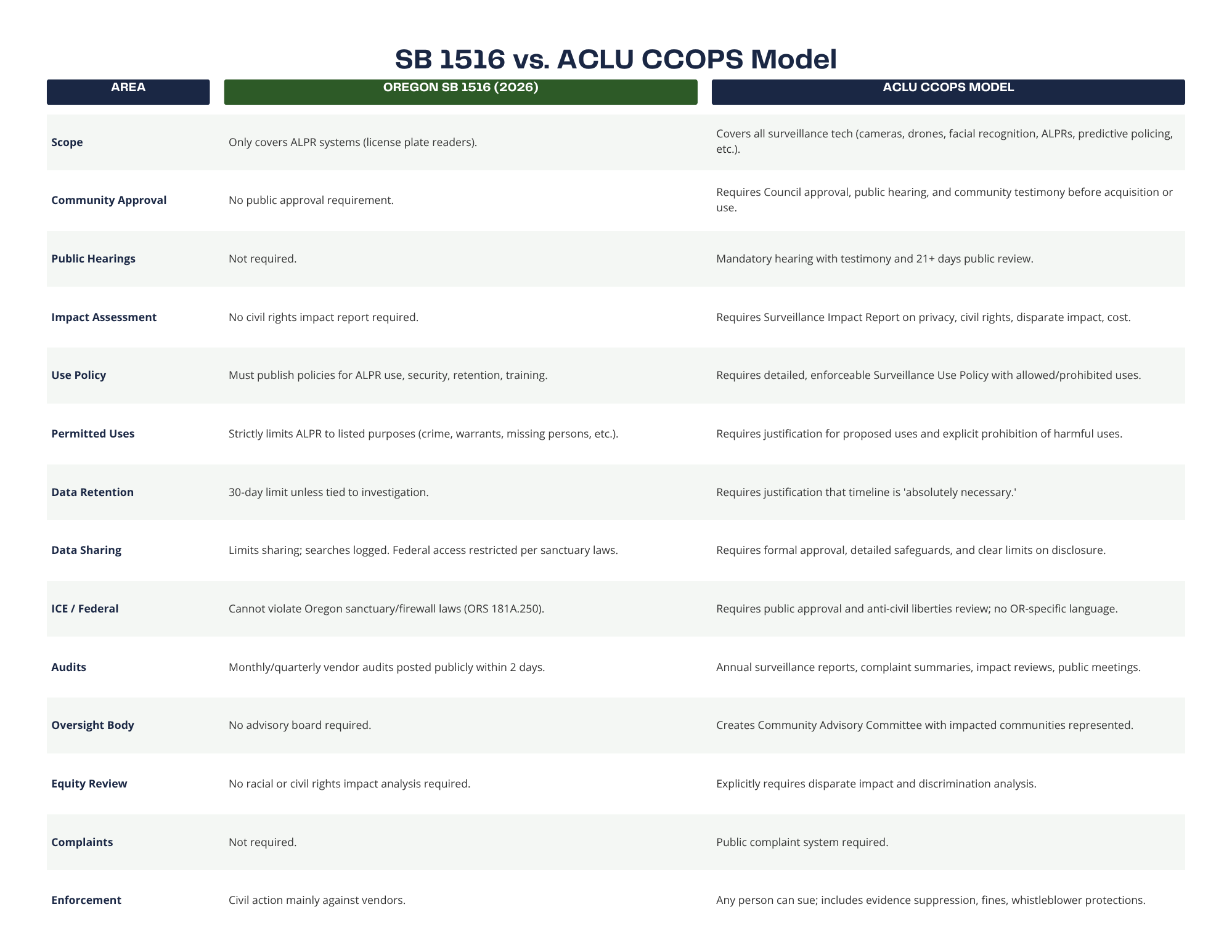
Oregon already restricts this. Senate Bill 1516 passed the Legislature in March 2026 and, under its emergency clause, took effect on passage. It says a vendor “may not access, disclose, sell, share or otherwise use” captured license plate data, and it defines that data to include video, photographs, vehicle characteristics, and “any other related data or information collected by an automated license plate recognition system.” It caps retention at 30 days. It requires the department to publish a policy covering “the retention and destruction of captured license plate data.” It lets any person go to court to stop a vendor that violates it, and it lets a person whose data was misused sue for damages and attorney fees. A contract signed before the law took effect may run to its end, but it cannot be renewed unless it meets the new terms. So the question for North Bend is not only what Flock’s contract permits. It is whether the department has published the state-required policy, and whether that policy says what happens to an image after Flock modifies it.
Who can order it destroyed? The contract gives the city no such power. Deletion happens only if the city asks for it, and only when the agreement ends. Section 5 says confidential information is deleted within 90 days at the customer’s request, and the same section excuses Flock from deleting data it says it must keep, naming audit-log integrity and metadata held to authenticate evidence. Sections 1, 4, and 5 survive termination. Nothing in the contract requires Flock to delete a derivative, a model, or a training image.
The city owns the picture. Flock owns what it makes from the picture. Only Flock knows when the second thing is gone.
What the department cannot get back. The contract defines “Flock Property” to include “any derivative works, intermediate or final outputs, analyses, reports, models, or other results generated by or through the Flock Services.” The contract says the customer has no right to download, extract, export, or keep copies of those outputs. Once Flock derives something from an image, that output belongs to Flock.
The open question. Some copies are documented and permitted. Training data is one. Traffic statistics are another. Images marked as evidence are kept longer. What we have not found is any public source showing that the plate image itself is kept somewhere else inside Flock after the 30 days. Flock says deleted data is “permanently deleted and irrecoverable.” If a copy of the image survived, that would breach the contract. Ask the city three things in writing. Does North Bend’s agreement include Traffic Analytics? Does deletion mean that no copy is kept anywhere? What is in a training image, and when is it deleted?
Source: Flock Safety, “Terms and Conditions,” sections 1.12 and 4.1 (August 21, 2026); Flock Safety, “Privacy Policy,” Training Data (October 16, 2026); Flock Safety, “Data Privacy and Protection”; Flock Safety, “License Plate Reader Policy”; Flock Safety, “What Is Traffic Analytics?”; North Bend OR PD, Flock Transparency Portal (captured November 2, 2026); Wausau Pilot & Review, “Is Flock selling your data?” (September 24, 2026); Wausau Pilot & Review, “Wisconsin agencies pull Flock cameras” (September 4, 2026).; Oregon Senate Bill 1516 (2026), enrolled text, sections 3, 4, 7 and 9.
Closing Ask to Council
Please:
- Release the written policies, training materials, and data-sharing agreements.
- Provide transparency about who can access this information.
- Create meaningful community oversight through a CCOPS model.
- Ensure impacted community members have a voice in accountability.
Public safety and civil rights work together. Trust is built when communities are included, informed, and heard.
Those who would give up essential Liberty, to purchase a little temporary Safety, deserve neither Liberty nor Safety.
Benjamin Franklin
Documents
Contact: jess@coosindivisible.org