
Universal Health Care, told in people
Six stories, told in people instead of spreadsheets. Every number below is checked and comes from a source you can follow to the bottom of this page (54 of them). Where the record is split, this page says so rather than rounding it off.
STORY ONE: THE FAMILY THAT STOPPED BLEEDING
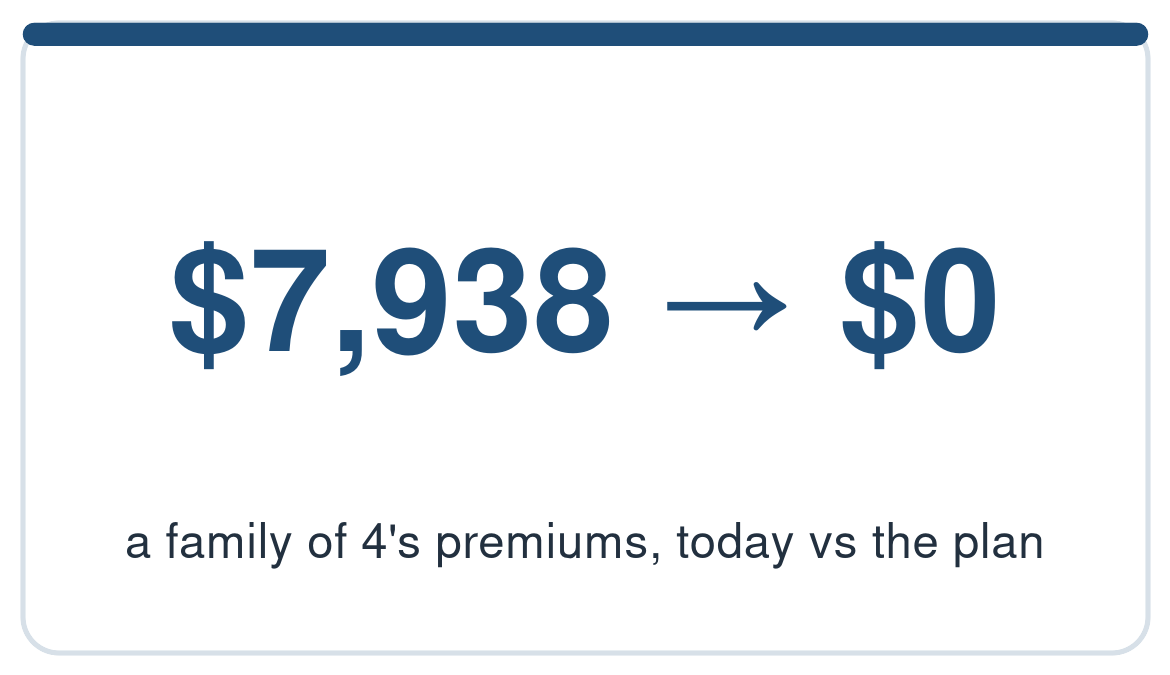
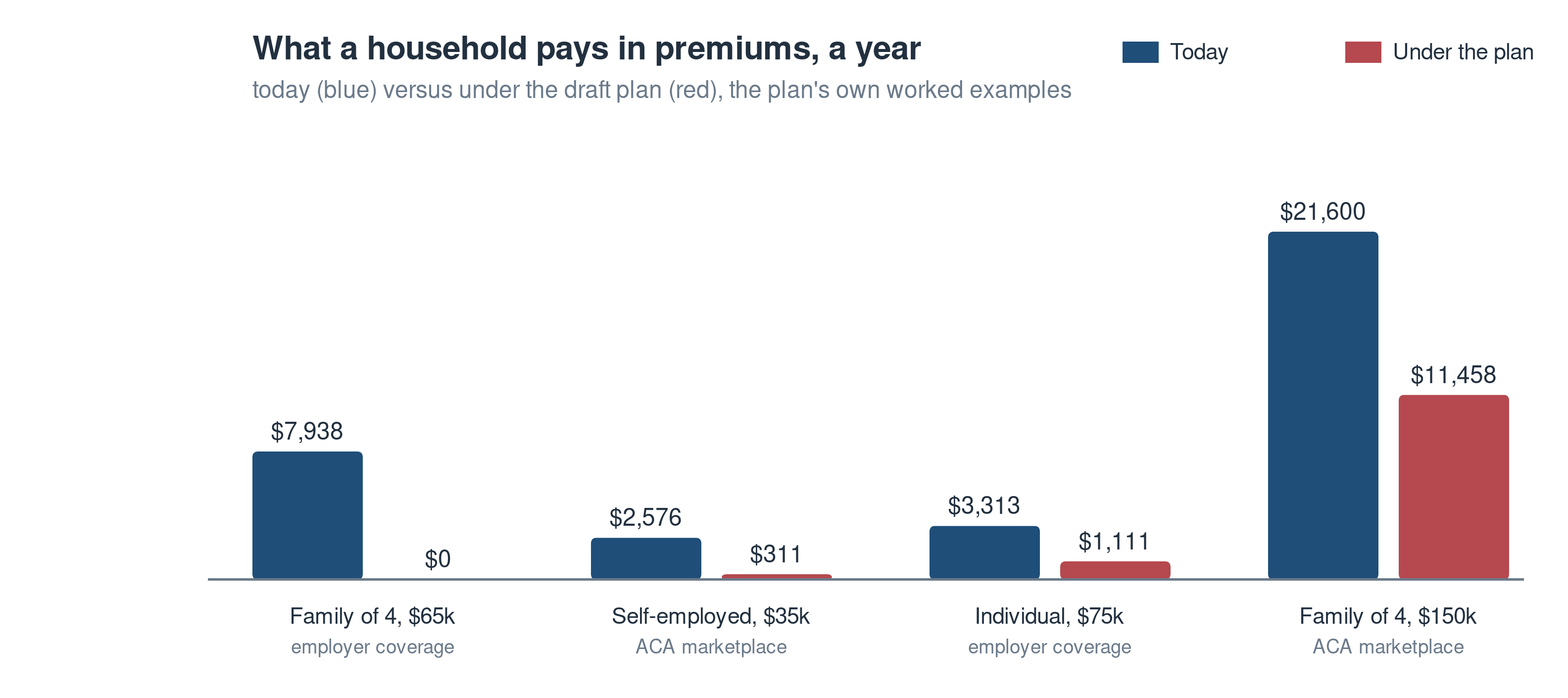
Picture a family of four in Coos County. Mom works a job with coverage, dad picks up shifts when he can, two kids, and the budget has exactly zero room in it. Every January they do the same math: $7,938 a year in premiums before anyone has seen a doctor. That is one bill. Deductibles and copays come out of the same thin envelope on top of it. It is the price of being allowed to get sick without going broke, and it is more than most of their month.
Now the same family, same income, same four people, under the draft plan’s worked example. They pay $0. Not less. Zero. [1]
The self-employed neighbor is the version people do not believe. She clears about $35,000, buys her own coverage on the ACA marketplace, and hands over $2,576 a year in premiums for the privilege of staying nervous. Under the plan’s example that drops to $311. [1] That is the difference between coverage being a roof and coverage being the next thing that caves it in.
Two honesty notes before the story writes its own ending. First, the “now” column is premiums only; deductibles and copays on top are not in the sources for these tiers, so the true gap between today and the plan is larger than the premium line shows, not smaller. Second, households below 200% of the federal poverty line pay nothing in the draft described to focus groups, higher earners generally pay more than they do today, and the exact figures depend on rates the Legislature has not set. [1] [2] These are projections, not law. They are still the difference between a family that breathes and one that does not.
STORY TWO: THE PROCEDURE THAT GOT DONE
Somewhere in this county someone’s back went out, or their chest did, and the scan came back with a finding that needs a second look. Not subtle care. The kind you cannot talk yourself out of. In the system we have, that person’s first question is not the finding. It is whether they can afford the finding. And the finding waits while the money gets arranged, and sometimes it waits until it stops being routine.
The numbers behind that wait are not soft. 66.5% of bankruptcy filers in 2019 cited medical expenses or illness-related work loss as a contributor. [3] 41% of American adults hold medical or dental debt. [4] A quarter of adults skip recommended care because of cost. [5] An econometric study reads the stream differently and puts the share of bankruptcies actually caused by an admission near 4%, or 6% among the uninsured. [6] Both are real; they measure different things. What is not disputed is that a medical debt is the tipping point in a family already close to the edge.
Now put that person in a plan with no bill at the point of service in the zero-cost-share example. [1] The finding gets a second look because a second look is medically right, not because someone has weighed it against the mortgage. The procedure happens because it should happen. The person is the whole consideration, and for the first time the question they are asked is about their health and not their bank.
And we are not guessing what that does to people. Oregon ran the experiment on itself. The Oregon Health Insurance Experiment, published in the New England Journal of Medicine, found that giving people coverage produced no measured jump in physical health in the first two years, then turned the honest corner: it cut the probability of a positive depression screen by 9.15 percentage points, raised the use of preventive care, and nearly eliminated catastrophic out-of-pocket medical spending. [7] That is what coverage buys and it is immediate: peace of mind today, physical health later. The peace of mind is not a warm feeling. It is the difference between a procedure that happens and one that does not.
STORY THREE: THE HOSPITAL THAT STAYED OPEN
Bay Area Hospital is 172 beds, the largest hospital on the Oregon coast, and the only medical centre within a two-hour drive of Coos Bay where a patient can deliver a baby, get advanced cardiac care, or have chemotherapy. [8] When it died, a whole county’s health went with it. It nearly did die.
The Legislature had to pass House Bill 4075 to set aside up to $44 million of unclaimed-property money to guarantee its refinancing loan, and the Senate passed it 16 to 12: one vote short would have killed the hospital. [9] After $22 million of operating cuts it posted its first profit in more than two years and vowed it “will not shut down,” [10] though the record disagrees on the loan size and this page keeps the disagreement rather than averaging it: OregonLive says $44 million, KOBI5 describes a $47 million default. [9] [8] Hospital officials told lawmakers that shrinking to a 50-bed Type B hospital would likely cause at least 180 preventable deaths a year [53]. The Oregon AFL-CIO put the number at 182 deaths and 2,089 more patient transfers a year in its own testimony to the Legislature. [53] [8] That is the real cost of a rural hospital failing: not a number, but 180 people who would not be here.
Why did a hospital like this nearly die? Because our system pays hospitals by volume. A rural hospital treats the sickest patients, gets paid when it successfully treats them, and eats the loss when people delay care over cost and arrive sicker. [11] The draft plan’s payment model is the structural fix: a prospective global budget instead of payment per procedure, with a target that global budgets reach about 70% of hospital spending. [12] A hospital paid a budget does not need patient volume to survive. Eleven Oregon hospitals have already joined forces in the Cascades network to cut costs and coordinate care. [13] The math is not speculative; it is the difference between keeping a specialist in town and losing the only building in 40 miles that has one.
The part nobody says out loud
WHY THE RICH BENEFIT
Here is the part nobody in the spending debate says out loud: the people with the most money benefit from a health system that is actually there when they need it, right along with everyone else. They may not need it as often, but they need it just as surely. And the honest way to frame what this plan is, is to call it what it is: a transfer.
A society that is cared for is a society that produces. Healthy people show up, build things, buy things, and keep the economy moving. That is not charity; it is arithmetic. The moment the hospital closes and the oncologist moves away, the money in the bank cannot buy back a doctor who left. The richest person in the county cannot summon a cardiac team to an empty building. Their money is only worth something when the doctors, the hospitals, and the specialists are still around to accept it.
So yes, call it a transfer, and say plainly what it transfers. It takes money spread across everyone and trades it for a system that is actually there when anyone needs it, and the people at the top get their share of that. A cared-for workforce is a workforce that shows up, spends, and keeps the specialists in the county, and the people at the top of the economy take every bit of that gain. The rich are not asked to give up health care; they are asked to help guarantee that health care exists, and the top of the ladder is where some of the benefit lands. That is the deal, and it is worth making. Everyone at every income level gets held up by the same rope.
Precedent
THE PLACES THAT ALREADY DID IT
The doubt is fair: Vermont priced a plan and flinched, California costed one and let it die. But this is not a dream with no precedent. Two countries and one province made this exact switch in the last century, and their transitions sit in the record with names, dates, and people underneath. Here is what actually happened.
TAIWAN, 1995: the boy who nearly ran out of time. In February 1995 a family in Taiwan had run so low on money for their 15-year-old son’s leukemia that they were out of options. National health insurance was not law yet. “We were thinking of going to protest if the plan wasn’t implemented on March 1,” the boy’s mother told the papers. [14] The plan passed, and it went live on March 1 as promised. [14] Before it, only about six in ten Taiwanese had insurance, and the most likely people to be left out were children and the elderly. [14] The rollout was chaos: the cards were not ready, so people showed their national ID cards instead, and some doctors saw nearly 400 patients in a day. [14] But within a year most of the island was covered, and today more than 98 percent of Taiwanese are, with the same card for the richest and the poorest. [15] The boy’s treatment got a system behind it. Nobody in Taiwan argues about whether the system should exist; they argue about how to make it better. [14]
SASKATCHEWAN, 1962: the strike that settled it. In 1962 a Canadian province went head to head with its own doctors. Premier Tommy Douglas had signed Canada’s first public medicare law, to take effect July 1. The morning it took force, about 90 percent of the province’s doctors went on strike. “Keep Our Doctors” committees, egged on by the press, fought the plan, and most of the province’s one million people sided with the doctors at first. [16] The strike lasted 23 days and ended in a compromise; the doctors got the right to work outside the plan, and went back to work. [16] But here is what the strike actually settled: medicare stayed. A 1965 survey found most of those same doctors wanted to keep it, and within ten years every Canadian province had coverage [17]. [16] Today Canadians call medicare part of who they are, and Douglas was later voted the Greatest Canadian. [16] The people who swore the plan would wreck medicine in 1962 are the ones history credits with building it.
THAILAND, 2002: the families who stopped going broke Thailand’s rice farmers used to gamble on staying healthy. Near the end of 2001 almost 30 percent of the country had no insurance at all, and a catastrophic illness could burn through a family’s whole savings. The record is plain about what that looked like: some families saved for a year to pay one medical bill, some spent their entire savings, and some went into heavy debt, even bankruptcy, to keep a loved one alive. [18]
In 2002 the government launched the 30 baht scheme, a flat fee of about 70 cents a visit, and extended coverage to about 45 million Thais who had no other coverage. It was universal within a year. [19] The scheme is not perfect, and Thais say so freely; some hospitals still strain under the load. But it ended the part where an illness emptied a family’s savings and then the land that was collateral on the debt, and twenty years on it is still there. [18]
It is not only a thing of the past. Ireland is in the middle of its own move toward near-universal coverage right now, through a decade-long program with broad party support [20]. The door does not close after a country passes it once.
Three different paths, one shared lesson: none of them required the world to change first. Each was a political decision made by a normal country facing the same fear and the same lobbyists, and each is still standing decades later. That is the ceiling on the doubt. It has been done, by people no braver than us, in our own lifetimes.
The contrast
THE AMERICAN VERSION: WAITING FOR THE COMPANY TO SAY YES
Now the other side of the comparison, because the contrast is the whole point. In the countries above, the person’s doctor made the call and care went ahead. Here, a stranger at an insurance company makes the call and the person waits. These are real stories with names and dates, drawn from the reporting; the causation is argued in courtrooms, and this page lets the record speak for itself.
NATALINE SARKISYAN, 17, DECEMBER 2007. A leukemia patient since age 14, she got a bone marrow transplant from her brother, then a complication shut down her liver. Her doctors at UCLA told the insurer she needed a liver transplant while one was available; four doctors wrote asking it to pay, citing a 65% six-month survival rate in similar cases. Cigna refused, twice, calling the transplant “experimental, investigational and unproven.” [21] Ten days passed while the paperwork went back and forth, and in that time she developed a lung infection. About 150 nurses and community members held a rally outside Cigna’s office. The company reversed its decision. She died hours later, at 5:50 p.m., on the same day coverage was finally approved. [21] Her attorney told the Los Angeles district attorney’s office he would pursue charges. Cigna defended the initial denial, saying it was based on a lack of medical evidence. [21] The family’s question, in the lawsuit: the transplant window closed while a form was being contested.
ALEXANDER SCHRIFT, 35, MAY 2025. He was diagnosed with a brain tumor in 2022. After his insurance company refused to cover the drug ribociclib, which researchers at Dana-Farber and the Institute of Cancer Research in London said showed promise for his type of tumor, he and his family appealed. The company refused to pay. [22] On May 12, less than two months after the denial, he died at home in San Antonio, Florida. His doctors at the treatment center described what he’d been offered and what the insurer’s refusal cost him; the obituary his family wrote begins with the care he could not get. [22]
DAN HURLEY, AUGUST 2023. His wife Traci is a nurse. Their insurer called the tests and treatments Dan’s doctors ordered “not medically indicated” and would not cover them. [23] Dan died on August 3, 2023. A week later, a letter from the insurance company arrived asking Traci to pay $80,000 for a round of chemotherapy that had been pre-authorized, then retroactively denied. [23] Traci’s point, in her own words: “The act of signing that denial is practicing medicine.” She has spent years arguing insurers should be held to the same standard as doctors, liable for malpractice when a denial turns out wrong. [23]
None of this is rare. In 2024, insurers denied about one in five in-network claims. [23] Roughly 17% of Americans said in 2023 that an insurer refused coverage for care their own doctor recommended. [24] And the most damning number is the quiet one: fewer than 1% of denials are ever appealed, even though people win appeals about half the time. [23] The system works the way it is built. In Taiwan, a family with a dying child does not debate whether “experimental” means “your son dies.” That fight exists here, every day, and it has a body count.
The opening
WHY OREGON CAN BE THE ONE TO PASS IT
Vermont priced it and flinched. California costed it and let it die in committee. Those are the honest warnings, and this page will not wave them away. But Oregon is not starting where either of those states started, and that is the difference worth saying plainly.
Not every single-payer vote has passed, and that is the honest part. Colorado’s ColoradoCare lost 79 to 21 in 2016, California’s Proposition 186 failed in 1994, and Switzerland turned down a public insurer 61.8 to 38.2 in 2014 [25]. The job is not to pretend it always wins; it is to make the case well enough that this time, in this state, it does.
Oregon already has the right. In 2022, voters passed Ballot Measure 111 and made Oregon the first state in the country to put health care in its state constitution as a fundamental right. [52] [26] The legislature does not get to keep ignoring that mandate forever; it is now obliged to build toward it.
Oregon has the fight. The same legislature recently passed and signed SB 951, taking on for-profit forces in health care. [26] The appetite to stand up to the industry exists and has produced law, not just rhetoric.
Oregon has done the work. Three years on a legislative task force, then a three-year governance board process, both researching the question from every angle before one line of financing was argued. [26] That is not the same as Vermont’s single report or California’s lone analysis. The homework is done, and the board created by Senate Bill 1089 in 2023 holds meetings open to the public on the third Thursday of every month. [26]
And the board’s own five guiding principles are worth putting on a wall: health equity, maximize health, fair distribution of medical resources, minimize financial hardship, and a community sense of ownership and governance. [26] This is not an abstract policy exercise. It is a design built on a public mandate, with a hard deadline and a place for your voice in it.
The numbers
THE MATH, HOUSEHOLD BY HOUSEHOLD
The stories above rest on the draft plan’s own worked examples. Every row is labelled PROJECTION in the verified sheet, because none of it is law.
See the household-by-household examples and the chart
| Household | Premiums now | Under the draft plan |
|---|---|---|
| $65,000, family of four, employer coverage | $7,938 a year in premiums now | $0 in the draft plan’s example. |
| $35,000, self-employed, ACA marketplace | $2,576 a year in premiums now | $311 under the plan’s example. |
| $75,000, individual, employer coverage | $3,313 now | $1,111 under the plan. |
| $150,000, individual, employer coverage | $3,313 now | $5,446 under the plan. This is the first tier where the plan’s example costs more than today’s premiums. |
| $150,000, family of four, ACA marketplace | $21,600 now | $11,458 under the plan. |
| $150,000, self-employed, ACA marketplace | $6,000 now | $11,926 under the plan. This is the cliff where the example flips. |
The honest part
WHAT IT WOULD TAKE (AND WHAT IS NOT DECIDED)
Now the honest part, because the stories only deserve to be told if the hard numbers are told alongside them. But here it is with the jargon cut out.
See the honest numbers and the full case
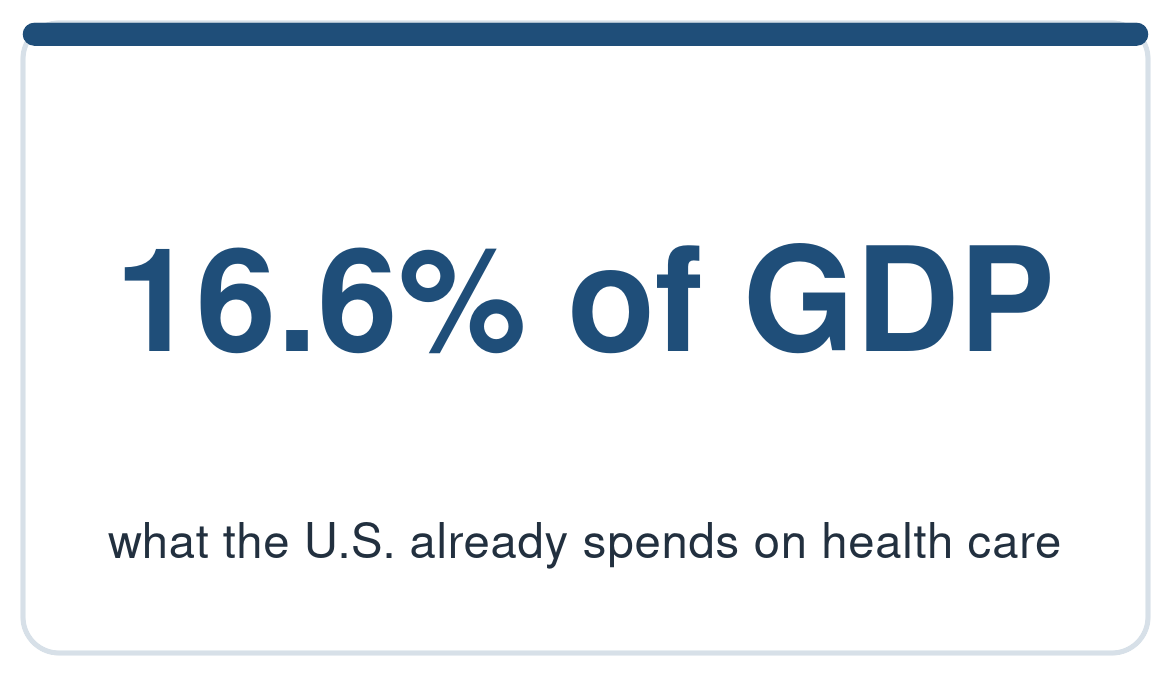
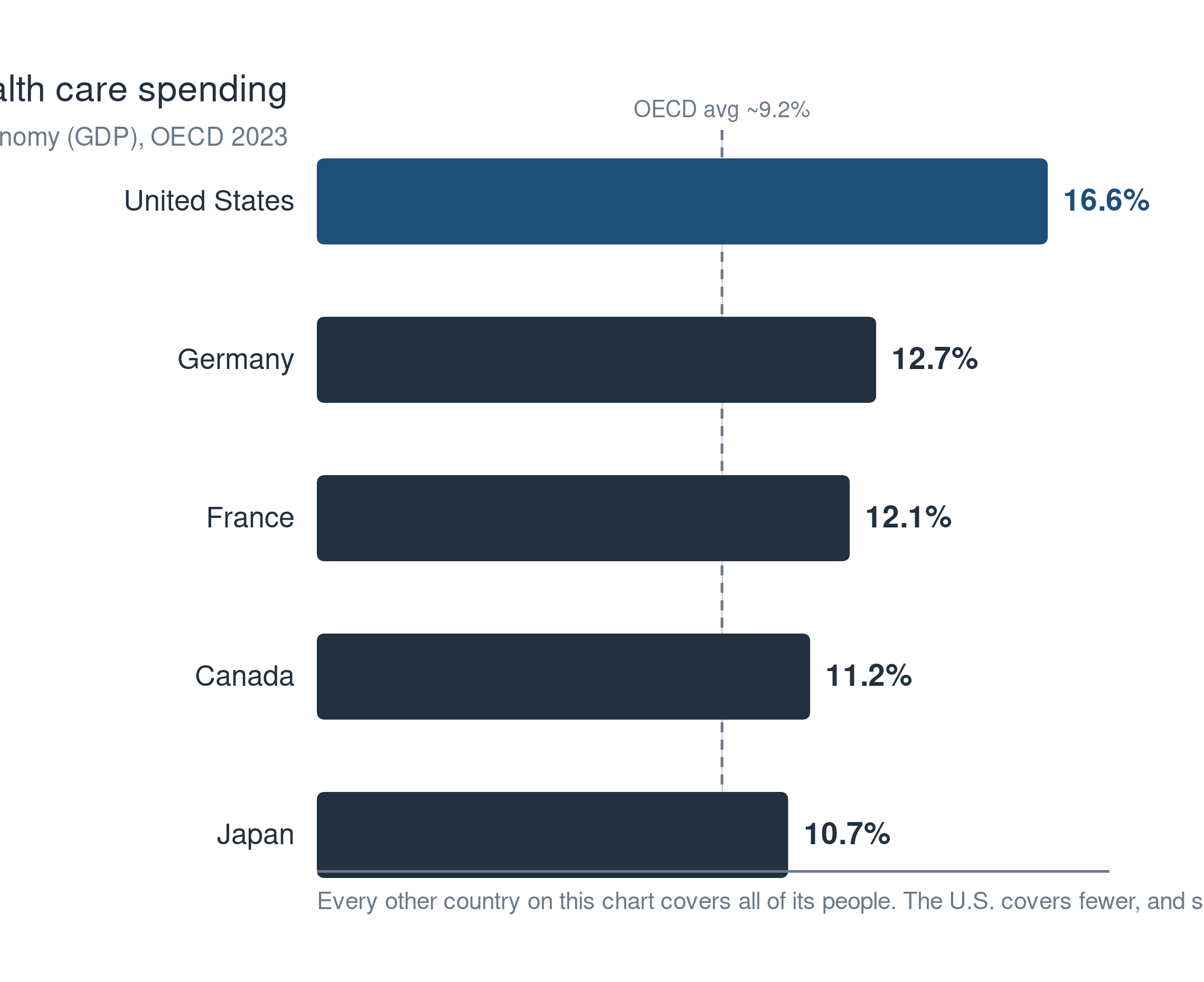
The money is already being spent. The U.S. already pays more for health care than any country on Earth. Measured the one fair way, as a share of the whole economy, the United States spends 16.6% of GDP on health care, while Germany spends 12.7%, France 12.1%, Canada 11.2%, and Japan 10.7%, and each of those countries covers nearly all of its people. [27] We pay the most, and we cover the fewest. And it is not buying more life: American life expectancy is 78.9 years, and healthy life expectancy 64.6 [28] while several countries that spend half as much on health live longer. The claim that “we can’t afford” a plan that covers everyone runs straight into the fact that we already outspend every country that does.
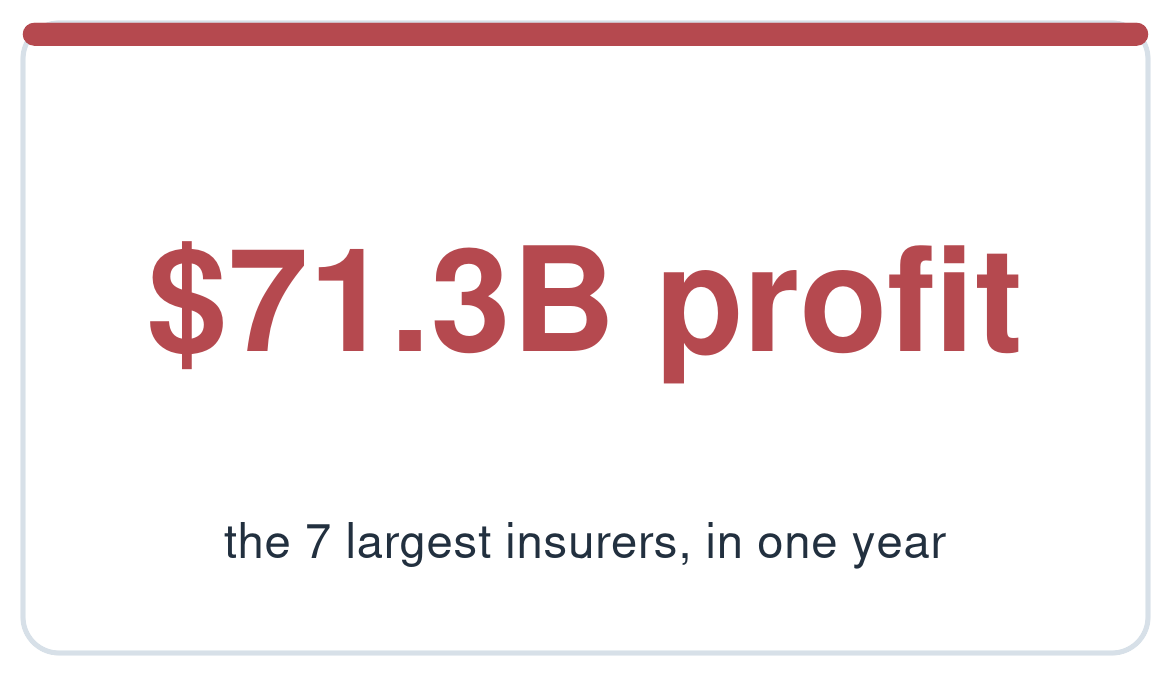
So who walks away with it? Not the people you see when you are sick. Rural hospitals are closing all over the country: 193 have closed or ended inpatient care since 2005, and more than 2 in 5 rural hospitals were operating at a loss in 2023. Rural independent pharmacies are closing too, at a rate that keeps widening the country’s pharmacy deserts. [29] [30] The numbers run deeper: 155 rural hospitals have closed or converted since 2010, and more than 40% of remaining rural hospitals operate at a loss on a median margin of just 1.0% [31]. The people at the billing desk are doing fine, thanks. The seven largest health insurers took in $71.3 billion in profits in 2024, and their CEOs took home $146 million combined. [32] A year earlier UnitedHealth alone posted $22.4 billion in profit, up 11% from the year before. [33] The same system that tells a rural hospital it is losing too much money pays its insurers record profits every year. That is where the premiums go. It is not going to nurses or doctors or the hospital that closes; it is going to the company that said no.
And they will not go quietly. Universal health care changes how much insurance companies make. Dollar for dollar, their profit is our premium, so every dollar they lose is a dollar they fight to keep. They have the money and the lobbyists to wage that fight, and the playbook was written long ago: tell us the plan will take away our insurance, put us behind bars, ration our care, and cost us more. It does none of those things, and it is paid for with less than the countries running it now pay. The misinformation will be loud, well-funded, and repeated until it feels true. It is on us to see it for what it is, and to vote our own best interests instead of their newest scare.
What it would take from Oregon is smaller than what these countries already put in. Several of them fund universal care with a contribution in the rough 10% range of income, employee and employer together. Japan runs it at about 10% of wages, Germany at about 16% as set by law. [34] [35] Oregon’s independent analysis puts the plan at 6.3% to 7.4% of personal income. [36] [37] We are not being asked to do something no one else does; we are being asked to do it for less than the countries already running it.
What was decided, and what was not. Decided: the benefits, that households under 200% of the federal poverty line pay nothing in the draft described to focus groups, that at least 15% of plan money goes to primary and preventive care, and that hospitals are paid a global budget rather than per procedure. [1] [2] [12] Not decided yet: exactly how to raise Oregon’s share. No governor and no ballot question can solve that on its own; it is a Legislature decision that is still open.
THE GAP, ONE NUMBER AT A TIME
One number to carry, not four.
The independent analysis (Milliman) puts the plan at $78.5 to $85.5 billion a year in 2032, with about $75.2 billion of that already accounted for by money Oregon collects today. The real hole is $30 to $35.5 billion a year. [36] [37]
Put that one number in plain terms.
- Per household: about $16,700 to $19,700 a year, which is under 7% of personal income for most families. [36] [37]
- What it replaces: In the draft’s examples the $65,000 family’s $7,938 of premiums becomes $0, and the $35,000 self-employed person’s $2,576 becomes $311. The tax is not an extra bill on top of today’s premiums; it takes the place of them. [1]
- The honest caveat: that gap is only reachable if the federal government lets Oregon redirect its Medicare and Medicaid money into the fund. The numbers above all assume that waiver. Without it, the plan is over twice as big and effectively stops. The federal waiver is not a detail of the financing; it is the financing. [36]
- The part people actually feel: the average Oregon household already spends about $31,700 a year on health care once premiums, out-of-pocket costs, and the tax share are added. Oregon’s 6.3% to 7.4% assessment is less than that for the average household. This is about swapping a quiet deduction for a visible tax, not about paying more. [37]
Two states ran this experiment and both stopped at the same place, and that is the honest warning. Vermont priced its plan at an 11.5% payroll tax plus up to 9.5% of income and the governor declined to recommend it, saying “the risk of economic shock is too high.” [38] California’s analyst put single payer at $449bn to $552bn a year with a $70bn to $193bn shortfall and the bill died in committee. [39] The lesson is not that universal care fails. It is that a cost without a pledge fails, and a ballot question without a coalition fails. Oregon’s version is still being argued in the open, which is exactly where that fight belongs.
For union members
WHAT HAPPENS TO YOUR GOOD UNION HEALTH PLAN?
Some of the loudest opposition to universal care comes from unions whose members have good insurance, negotiated in hard-fought contracts. The honest answer is that universal care asks something real of those members, and it gives something real back. Here is what changes, and what the change buys.
The first thing that changes is who you have to think about. Under a universal plan, a member who is already covered well would mostly stop worrying about the insurance itself: no more checking who is in network, no more switching doctors because an employer changed plans, no more pre-authorization hoops before the care you were told you need, and the freedom to choose the doctor you want rather than the one the plan allows. [40] The coverage does not exist anymore as something an employer can change or take away.
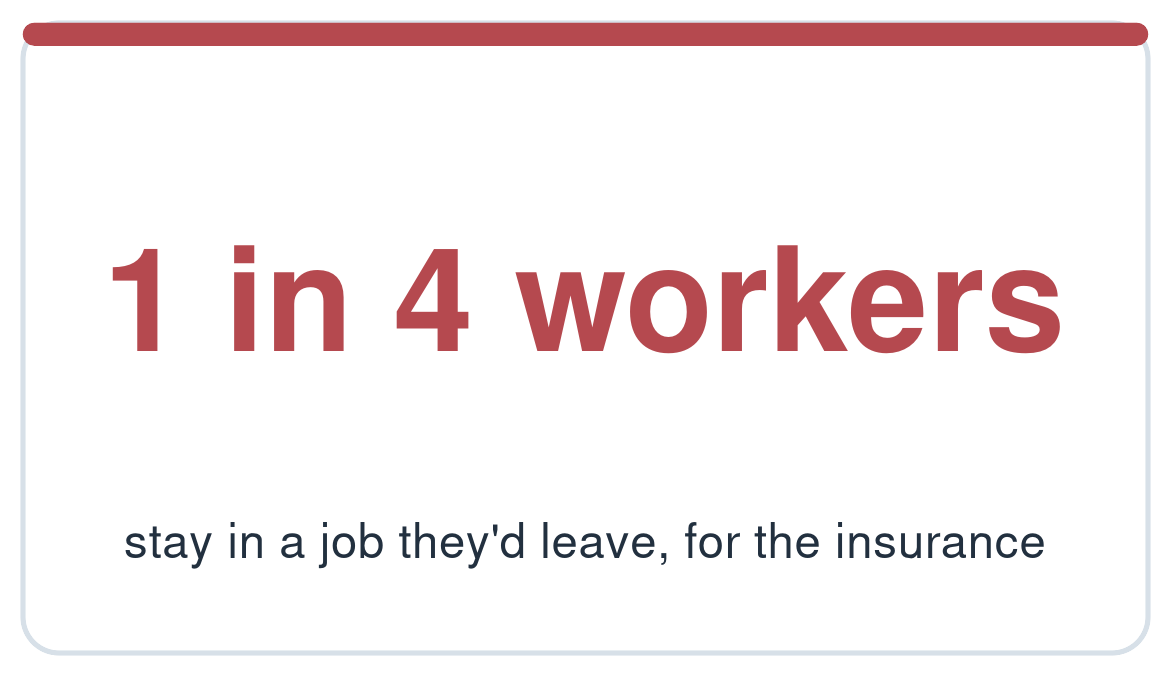
The second change is that a good plan stops locking you to a job. Roughly one in four U.S. workers, about 23 million people, say they stay in a job they would rather leave because they are afraid of losing their health insurance. The number has climbed from 16% in 2021 to 24% now, and it is worse for people with chronic conditions or medical debt. [41] Under universal care, that reason to stay disappears. The job you hate stops being a hostage agreement; the doctor does not change if you quit, retire, get laid off, or go out on strike.
The third change is what happens to the money. Health care would no longer be the thing a union has to win, tooth by tooth, clock by clock. Research at the CBO and in labor economics finds that when employers stop paying health premiums, they pass most of those savings back to workers, and right now those premiums are worth roughly 7% of total compensation. [42] That is the pot that comes back. Louder voices at the table could put that money into retirement, wages, paid time off, or the things members actually asked for, instead of spending the whole fight on keeping the coverage they already had. [43] Some careful union economists argue the same savings can mean lower dues, because the health fund stops being the biggest bill a local carries. [44]
The honest trade. The richest negotiated plans, the luxury-car coverage some contracts have won, would lose their standing as a top bargaining chip, because that is the point: health care stops being something only some workers can win. That is why the Culinary Union warned its members in 2020 and why some unions split with single-payer campaigns even while backing the goal. [45] [43] No leader is wrong to protect what their members earned. But the question is whether the best answer for every worker is to keep a good plan for the few or to guarantee one for everyone, and then let the fight move to the things a plan can never buy: a real pension, paid time you can actually use, and a day’s work you are not chained to.
The statute
YOUR DOCTOR, PRECISELY
ORS chapter 751 gives the participant free choice of any licensed provider, and it forbids the plan from discriminating against a licensed provider acting within scope. [40] In plain language, that means no network to stay inside and no prior-authorization line to call: you see the provider who is right for you. [54]
Show me what the statute actually says
It does not compel providers to accept the fund, and this page does not claim that it does. The honest version of the promise is: you choose your doctor, and the plan is barred from steering you away from licensed providers who take part. That is the version the statute supports. [40]
The strongest objection
THE WAIT QUESTION, HONESTLY
25.6%
of American adults skipped recommended care because of cost, against 4.6% to 20.4% in the other nine countries. [5]
The strongest objection is the wait, and it is partly true, so here is the wait in full.
Show me the waits, and the trade
Canada’s 2025 physician survey puts the median wait from referral to treatment at 28.6 weeks. [46] NHS England had 7.4 million pathways waiting in August 2026. [47] And the people who live under those waits are not pretending it is fine: only 26% of Britons said they were satisfied with the NHS in 2025 [48]. The honest trade cuts both ways. The Commonwealth Fund’s 2023 survey puts the United States fastest of ten countries on specialist and surgical waits. [5] Those are real and they are why the “everyone else does it” bumper sticker is dishonest.
But the same survey shows the American trade is not absence of waiting; it is rationing by price instead of by queue. 25.6% of American adults skipped recommended care because of cost, against 4.6% to 20.4% in the other nine countries. [5] Canada waits for a hip; Americans go without the hip, then without the wages when it gives out, then without the house. Waits track capacity, not the payment model. The question is which wait you would rather have: a wait for a hip, or no hip.
Test it yourself
MYTH VS FACT
Seven claims that circulate in Oregon about this plan, and what the record actually shows.
See all seven claims and what the record shows
Myth: “The health plan makes criminals of small business owners.” The claim is built on a real bill that has nothing to do with health care. The criminal liability comes from HB 4089 (2026), “Relating to criminal offenses related to work”, a wage-theft and contractor-licensing bill. It makes a contractor who knowingly hires an unlicensed construction labour contractor guilty of a Class A misdemeanor (Class C felony on a prior conviction), and upgrades licence-number misuse to a Class C felony. [49] None of that touches health finance, and every offence needs “knowingly” or intent to deceive. A filing mistake is not a crime. The abuse the law targets is real and concentrated: ICN payroll audits from 2015 to 2019 found 16,164 misclassified workers and $131.7 million in unreported payroll. [50] The $500,000 payroll exemption is aimed at exactly the shops that already comply. [37] [12]
Myth: “Nobody knows how to pay for it.” People know exactly how to pay for it; the United States already does. We spend 16.6% of GDP on health care, more than any country that covers everyone. [27] The countries doing this do not wonder whether it is possible; they fund it with a contribution of income, employee and employer together. The true statement is narrow: Oregon’s board has not chosen a financing model yet, and the independent analysis shows a real $30bn to $35.5bn a year gap that no single tax fully closes on paper. [37] [12] That is a decision, not a mystery. “Undecided” and “unknown” are different words, and the difference between them is why your voice in the comment period matters.
Myth: “Universal coverage means the state assigns you a doctor.” The statute runs the other way. ORS chapter 751 gives the participant free choice of any licensed provider. [40] What it does not do is force a provider to accept the fund, and this page does not claim otherwise.
Myth: “Our emergency rooms are the bottleneck.” Oregon’s emergency departments beat both the national and state medians on arrival-to-departure time, and Bay Area Hospital had 0% of patients leave before being seen. [51] The county’s problem is hospital finance and Medicaid dependence, which is why the structural fix is paying hospitals a global budget instead of per procedure. [12] [8]
Myth: “Medical bankruptcy is a myth.” 66.5% of bankruptcy filers in 2019 cited medical expenses or illness-related work loss as a contributor. [3] An econometric study puts the share caused by an admission near 4%, or 6% among the uninsured. [6] Both are real; they measure different things. The argument is not that a hospital bill alone drives people to court. It is that a hospital bill is the tipping point in a family already close to the edge.
Myth: “Universal coverage means long waits for everyone.” Covered honestly in the section above. The trade is real, and it is between a wait for a hip and no hip.
Myth: “This is already law, so the fight is over.” The bill that passed created the governing board and rate-setting authority, not the plan itself. The board owes the Legislature its implementation plan on 1 December 2026, and no financing model is written. [36] [37] [12]
Remember this
THE TAKEAWAY
A family of four that paid $7,938 a year in premiums pays $0 in the draft plan’s own example. [1] A person who needed a procedure got it because there was no bill at the point of service, and Oregon’s own experiment says the peace of mind arrives first. [7] A hospital that nearly closed its doors stays open because a hospital paid a budget does not need patient volume to survive. [12] [8] And everyone, including the richest person in the county, holds up the same rope: a doctor who leaves, a specialist who moves away, an empty building with no cardiac unit, and the money in the bank cannot buy back any of it.
None of it is law yet. The board owes the Legislature its implementation plan on 1 December 2026, the financing model is still unwritten, and the $30bn to $35.5bn gap is the number to watch. [1] [36] [37] [12] Not because the gap is the story. Because the gap is the door, and the public comment window is open now. The people in these stories do not need us to decide the policy for them. They need us to show up for the meeting where the policy gets decided.
Your move
WHAT YOU CAN DO
The plan is not written yet. That is the opening, not the problem. The Governance Board owes the Legislature its implementation plan on 1 December 2026, and the public comment window is open now. Here is the road ahead, straight from the board: the plan goes to the Legislature in December, lawmakers most likely refer it to voters as a ballot measure in 2028, and a win in 2028 starts the rollout in 2030 to 2032. [26] The finishing line is real, and the stories above only end well if the funding question is answered out loud between now and then.
- Thursday 19 November, 8:45am: Universal Health Plan Governance Board meeting, Salem and virtual. Public comment is taken at the meeting, which is where the cost-share floor and the exemption threshold actually get decided.
- Saturday 21 November, 11am: Universal Health Plan Crash Course, virtual. The board’s own design, explained in one sitting.
- 1 December 2026: the board’s implementation plan is due. That document, not this page, is what the Legislature will vote on.
One caution for anyone quoting this page in public: the criminal liability story you will hear attached to this plan belongs to a different bill. Get the bill right or the rest of the paragraph stops being heard.
You do not have to attend a meeting to be heard. The board says it reads every written comment submitted and treats written comments as its primary method of receiving public input. Submit at https://www.oregon.gov/uhpgb/Pages/public-comment.aspx, or write to the seat of the whole board and the Community Engagement Committee that meets the fourth Wednesday of every month. [26] A written comment from a name in Coos County counts exactly as much as one from Portland, and the board is listening for exactly the stories told above.
Every number, traced
SOURCES
Show all 54 sources
STORY ONE: THE FAMILY THAT STOPPED BLEEDING
- [1] HCAO, draft plan details (benefits, who pays what; the worked examples, labelled PROJECTION in the verified sheet). https://www.hcao.org/draft-plan-details
- [2] HCAO town hall survey summary, April 2026 (504 responses), archived by the UHP Governance Board. https://www.oregon.gov/uhpgb/Documents/commitee-meetings/community-engagement-communications/2026/20260527/202604-HCAO-health-care-reform-town-hall-survey-summary.pdf
STORY TWO: THE PROCEDURE THAT GOT DONE
- [3] Himmelstein DU, Thorne D, Warren E, Woolhandler S, “Medical Bankruptcy: Still Common Despite the Affordable Care Act,” American Journal of Public Health 109(3):431-433 (2019). https://pmc.ncbi.nlm.nih.gov/articles/PMC6366487/
- [4] KFF Health Care Debt Survey (2022): 41% of adults hold medical or dental debt; 3% of indebted adults filed for bankruptcy. https://www.kff.org/health-costs/kff-health-care-debt-survey/
- [5] Commonwealth Fund, International Health Policy Survey 2023, cost and access tables (specialist and elective-surgery waits; skipped care due to cost). https://www.commonwealthfund.org/publications/surveys/2023/nov/cost-not-getting-care-income-disparities-affordability-health
- [6] Dobkin C, Finkelstein A, Kluender R, Notowidigdo MJ, “Myth and Measurement: The Case of Medical Bankruptcies,” New England Journal of Medicine 378:873-875 (2018). https://pmc.ncbi.nlm.nih.gov/articles/PMC5865642/
- [7] Baicker K, Taubman SL, Allen HL, et al., “The Oregon Experiment – Effects of Medicaid on Clinical Outcomes,” New England Journal of Medicine 368:1713-1722 (2013). https://www.nejm.org/doi/full/10.1056/NEJMsa1212321
STORY THREE: THE HOSPITAL THAT STAYED OPEN
- [8] OregonLive, March 2026, Bay Area Hospital investigation (172 beds, the two-hour specialty radius, the $44 million figure, the 50-bed Type B scenario and the 180-death estimate). https://www.oregonlive.com/politics/2026/03/a-hospital-on-oregons-coast-was-on-the-brink-of-catastrophe-until-an-unlikely-alliance-stepped-up.html
- [9] KCBY, Oregon lawmakers approve $44 million loan guarantee for Bay Area Hospital (HB 4075, Senate 16 to 12). https://kcby.com/news/local/oregon-lawmakers-pass-bill-to-back-bay-area-hospital-loan-with-up-to-44-million
- [10] KCBY, Bay Area Hospital posts first profit in more than two years after $22m in cuts. https://kcby.com/news/local/bay-area-hospital-posts-first-profit-in-more-than-two-years-after-22m-in-cuts
- [11] CBS News, “Oregon eyes nation’s first universal healthcare system” – medical debt as a leading cause of bankruptcy; patients delaying care over out-of-pocket costs. https://www.cbsnews.com/news/oregon-universal-healthcare-single-payer-plan/
- [12] UHP Governance Board Legislative Brief, October 2026 (15% primary-care floor, global budgets targeting about 70% of hospital spending, no single financing model recommended). https://www.oregon.gov/uhpgb/Documents/board-meetings/2026/20261015/legislative-brief-10142026.pdf
- [13] KOBI5, State approves Cascades rural hospital network. https://kobi5.com/news/state-approves-lifeline-cascades-network-for-rural-hospitals-317545/
- [53] Oregon AFL-CIO, written testimony to the House Committee on Health Care on HB 4075, February 2026 (Bay Area Hospital’s refinancing): without state help the hospital would likely downgrade to a Type B facility, meaning “an estimated 2,089 more patient transfers and 182 preventable deaths per year,” plus closure of behavioral health and labor-and-delivery services. https://apps.oregonlegislature.gov/liz/2026R1/Downloads/PublicTestimonyDocument/237571
THE PLACES THAT ALREADY DID IT
- [14] Taipei Times, “Taiwan in Time: Saying no to universal healthcare” (2019-07-14), national health insurance implemented March 1, 1995; before it ~54% insured, children and elderly most likely uninsured; the 15-year-old leukemia patient’s family planning to protest if the plan did not launch; chaotic rollout, doctors seeing nearly 400 patients a day; nobody now disputes the system should exist. https://www.taipeitimes.com/News/feat/archives/2019/07/14/2003718621
- [15] Taiwan National Health Insurance Administration, annual report (coverage over 98%, about 22.3 to 23 million people; administrative cost 1.3% to 1.66%); Health Affairs, “Taiwan’s single-payer National Health Insurance at 30.” https://www.healthaffairs.org/content/forefront/taiwan-s-single-payer-national-health-insurance-30-years-part-2-lessons-learned-and
- [16] CBC, “Medicare birth pangs are never easy” and CBC History archive, Saskatchewan doctors’ strike 1962 (about 90% of doctors on strike from July 1; “Keep Our Doctors” committees; public initially sided with doctors; 23-day strike ending in the Saskatoon Agreement; a 1965 survey found most doctors favored keeping the plan; within ten years all Canadian provinces covered; Tommy Douglas later voted the Greatest Canadian). https://www.cbc.ca/news/canada/medicare-birth-pangs-are-never-easy-1.969921
- [17] Canada Health Act annual report, Health Canada. Provincial plans covered the population by 1972; documents the 1962 Saskatchewan Medical Care Insurance Act and the doctors’ strike. https://www.canada.ca/en/health-canada/services/publications/health-system-services/canada-health-act-annual-report-2021
- [18] Health Systems Research Institute (Thailand), “Universal Health Coverage: Case Studies from Thailand” (some families spent a year’s savings or their entire savings on one medical bill, went into heavy debt, some into bankruptcy, to keep a loved one alive; the 30 baht scheme later ended that). https://www.hsri.or.th / archived copy. https://www.who.int/docs/default-source/health-financing/thailand-uhc-summary.pdf
- [19] PMC, “Learning from Thailand’s health reforms” (universal coverage achieved 2002; about 30% uninsured before; 30 baht flat fee per visit, about US$0.70; extended coverage to about 45 million Thais). https://pmc.ncbi.nlm.nih.gov/articles/PMC314057/
- [20] OECD / European Observatory on Health Systems and Policies, Ireland: Health System Review (2023), and the Sláintecare implementation strategy (2018). A wealthy country already moving toward universal coverage. https://cdn.thejournal.ie/media/2024/03/slaintecare-implementation-strategy-2018.pdf
THE AMERICAN VERSION: WAITING FOR THE COMPANY TO SAY YES
- [21] Los Angeles Times, “Lawsuit blames Cigna’s liver transplant refusal for teen’s death” (2008-12-27) and LA Times/Glendale News-Press, “Leukemia patient dies at 17” (2007-12-22), on Nataline Sarkisyan, 17, who died December 2007 hours after Cigna reversed its denials of a liver transplant the family said she needed; Cigna had called the transplant “experimental, investigational and unproven”; about 150 nurses rallied; the family sued and the attorney pursued charges. https://www.latimes.com/archives/la-xpm-2008-dec-27-fi-livertransplant27-story.html
- [22] Orlando Sentinel, “‘Not accountable to anyone’: As insurers issue denials, some patients run out of options” (2025-07-03), on Alexander Schrift, 35, who died at home May 12, 2025, less than two months after his insurer refused to cover ribociclib, a drug researchers at Dana-Farber and the Institute of Cancer Research in London said showed promise for his brain tumor. https://www.orlandosentinel.com/2025/07/03/health-insurance-denials
- [23] CBS News, “State of denial: How insurance companies impact health care today” (on Dan Hurley, who died August 3, 2023, and whose widow Traci says his doctor-ordered care was denied as “not medically indicated”; a week after his death the insurer billed $80,000 for pre-authorized chemotherapy it retroactively denied). CBS analysis: 19% of in-network claims denied in 2024, and fewer than 1% of denials appealed even though people win about half. https://www.cbsnews.com/news/state-of-denial-how-insurance-companies-impact-health-care-today/
- [24] NBC News, “‘Would he have lived?’ When insurance companies deny cancer care to patients” (on Tracy Pike, who died January 2024 after BCBS of Illinois denied his doctor-recommended treatment as “not medically necessary”); citing the Commonwealth Fund, 17% of Americans reported in 2023 that an insurer denied coverage their doctor recommended. https://www.nbcnews.com/news/investigations/-lived-health-insurance-companies-deny-cancer-care-patients-rcna182611
WHY OREGON CAN BE THE ONE TO PASS IT
- [25] Ballotpedia, past single-payer ballots. Colorado’s ColoradoCare was voted down 79 to 21 in 2016; California’s Proposition 186 failed in 1994; Switzerland’s 2014 public-insurer referendum lost 61.8 to 38.2. A reminder that the idea has lost votes too. https://ballotpedia.org/Colorado_Creation_of_ColoradoCare_System
- [26] HCAO, “The Plan and the Process: The Universal Health Plan Governance Board” (board established 2023 under Senate Bill 1089; Ballot Measure 111 2022 making health care a constitutional right; SB 951; third-Thursday public meetings; written comment as primary input channel; five guiding principles; timeline of plan due Dec 1 2026, ballot measure in 2028, rollout 2030 to 2032). https://www.hcao.org/uhpgb
- [52] Oregon Constitution, Article I, section 47 (added by Ballot Measure 111, adopted 2022): “It is the obligation of the state to ensure that every resident of Oregon has access to cost-effective, clinically appropriate and affordable health care as a fundamental right.” https://www.oregonlegislature.gov/bills_laws/Pages/OrConst.aspx
WHAT IT WOULD TAKE (AND WHAT IS NOT DECIDED)
- [27] OECD, Health at a Glance 2023 (health spending as % of GDP: United States 16.6%, Germany 12.7%, France 12.1%, Canada 11.2%, Japan 10.7%; OECD average 9.2%; each non-U.S. country on that list covers nearly all of its people). https://www.oecd.org/en/publications/health-at-a-glance-2023_7a7afb35-en.html
- [28] WHO, World Health Statistics 2025; OECD, Health at a Glance 2024. U.S. life expectancy 78.9 years and healthy life expectancy 64.6 years. The country that spends the most does not live the longest. https://www.who.int/publications/i/item/9789240110496/
- [29] KFF, “10 Things to Know About Rural Hospitals” and UNC Sheps Center Rural Hospital Closures (193 rural hospitals closed or ended inpatient care from 2005 to 2024; more than 2 in 5 rural hospitals operating at a loss in 2023; 62 closed 2017-2024 vs 10 opened). https://www.kff.org/health-costs/issue-brief/10-things-to-know-about-rural-hospitals ; https://www.shepscenter.unc.edu/programs-projects/rural-health/rural-hospital-closures/
- [30] National Rural Health Association / National Community Pharmacists Association, on rural independent pharmacies closing at a rate deepening rural pharmacy deserts (2024-2025). https://www.ruralhealth.us/ ; https://ncpa.org/
- [31] UNC Sheps Center, Rural Hospital Closures; Chartis Center for Rural Health, 2026 Rural Health State of the State. 155 closures and conversions since 2010; more than 40% of rural hospitals operating at a loss; median rural margin just 1.0%. https://www.shepscenter.unc.edu/programs-projects/rural-health/rural-hospital-closures/
- [32] Wendell Potter / Common Dreams and Center for Health and Democracy, “Big Seven” health insurers analysis from Senate committee testimony (seven largest U.S. health insurers made $71.3 billion in 2024 profits; their CEOs took $146.1 million combined). https://www.commondreams.org/newswire/evidence-of-health-insurance-industry-record-profits-ceo-pay ; S&P Global / Beckers Payer, 2024 payer profits. https://www.beckerspayer.com/payer/payers-ranked-by-2024-profits/
- [33] Beckers Payer Review, “Big payers ranked by 2023 profit” (UnitedHealth Group $22.4 billion net earnings in 2023, up 11.2% year-over-year). https://www.beckerspayer.com/payer/big-payers-ranked-by-2023-profit-beckers/
- [34] JETRO, “Japan’s social security system” (Japan Health Insurance Association, Tokyo: health insurance premium 9.91% of standard monthly remuneration and bonus, split equally worker/employer). https://www.jetro.go.jp/en/invest/setting_up/section4/page9.html
- [35] KPMG, 2024 Social Security Thresholds and Rates; Personio, statutory health insurance 2024 (Germany: general contribution rate 14.6% of income plus an average ~1.7% supplementary contribution, split equally employer/employee). https://kpmg.com/xx/en/our-insights/gms-flash-alert/flash-alert-2024-003.html
- [36] Milliman, Expenditure Analysis for the Oregon Universal Health Plan ($78.5bn low-cost-share to $85.5bn zero-cost-share in 2032; about $75.2bn identified revenue). https://www.oregon.gov/uhpgb/about/Documents/milliman-final-report.pdf
- [37] Oregon Capital Chronicle, 2026-08-06, board punts single-payer report over funding uncertainty (the $75.2bn, the $30bn to $35.5bn gap, the payroll tax, the delay vote). https://oregoncapitalchronicle.com/2026/08/06/oregon-universal-health-care-board-punts-single-payer-report-over-funding-uncertainty/
- [38] Vermont Agency of Administration, Green Mountain Care financing report (2014-12-30), 11.5% employer payroll tax plus up to 9.5% of income; Governor’s “risk of economic shock is too high”. https://legislature.vermont.gov/assets/Legislative-Reports/GMC-FINAL-REPORT-123014.pdf
- [39] California Legislative Analyst’s Office, letter on AB 1400 (CalCare), 2022-03-15 ($449bn to $552bn a year; $70bn to $193bn shortfall). https://lao.ca.gov/letters/2022/Cooley-Cunningham-CalCare-031722.pdf
WHAT HAPPENS TO YOUR GOOD UNION HEALTH PLAN?
- [40] Oregon Revised Statutes, chapter 751, Universal Health Plan (participant choice of licensed provider; plan barred from discriminating against licensed providers acting within scope). https://www.oregonlegislature.gov/bills_laws/ors/ors751.html
- [54] Health Care for All Oregon (HCAO), “The Universal Health Care Plan” explainer: “Choose your own doctor. See any provider in Oregon without network restrictions or prior authorization”; no copays, deductibles, or surprise bills. Plain-language companion to the statute at [40]. https://www.hcao.org/uhpgb
- [41] West Health-Gallup Center on Healthcare in America, national study (2025-2026): nearly one in four U.S. workers, ~23 million adults, report “job lock”, which is staying in a job they would leave for fear of losing health insurance; up from 16% in 2021 to 24%; higher for people with chronic conditions (29%) or medical debt (44%). https://news.gallup.com/poll/712166/one-four-employees-locked-jobs-health-insurance.aspx
- [42] Congressional Budget Office, “Economic Effects of Five Illustrative Single-Payer Health Care Systems” (Working Paper 2022-02): under single payer employers would stop funding health benefits and would pass the savings to workers as higher taxable wages and other compensation; health insurance benefits are currently about 7% of total labor compensation. https://www.cbo.gov/publication/57637
- [43] Politico, “Some labor unions split with Sanders on Medicare for All” (2019-08-11). https://www.politico.com/story/2019/08/11/joe-biden-medicare-for-all-unions-1456179
- [44] AFL-CIO, Resolution 6, “Making Health Care For All a Reality” (2017 convention), backing single payer “while retaining a role for workers’ health plans”; 2019 statement on workers who gave up wages for coverage. https://aflcio.org/resolutions/resolution-6-making-health-care-all-reality
- [45] Nevada Independent, “In new flyer, Culinary Union warns members Sanders would end their health care” (February 2020), on the flyer sent to 60,000 members. https://thenevadaindependent.com/article/in-new-flyer-culinary-union-warns-members-sanders-would-end-their-health-care-i
THE WAIT QUESTION, HONESTLY
- [46] Fraser Institute, Waiting Your Turn: Wait Times for Health Care in Canada, 2025 (median 28.6 weeks; 13.1% response rate). https://www.fraserinstitute.org/studies/waiting-your-turn-wait-times-for-health-care-in-canada-2025
- [47] NHS England, Referral to Treatment Waiting Times, August 2026 release (7.4 million pathways; 65.2% within 18 weeks; 113,339 over 52 weeks). https://www.england.nhs.uk/statistics/statistical-work-areas/rtt-waiting-times/
- [48] National Centre for Social Research, British Social Attitudes 2025: public attitudes to the NHS and social care. 26% satisfied, 51% dissatisfied with the NHS overall; GP waits 27%, hospital waits 16%, A&E waits 14%. The honest version of the wait: even supporters are not happy with it. https://natcen.ac.uk/publications/public-attitudes-nhs-and-social-care
MYTH VS FACT
- [49] House Bill 4089 (2026), Enrolled, Relating to criminal offenses related to work; amends ORS 164.125, 658.991, 670.700, 701.990. ORS 658.991(7): Class A misdemeanor for knowingly contracting with an unlicensed construction labour contractor, Class C felony on a prior conviction. ORS 701.990(2) and (3): unauthorised or deceptive use of a contractor licence number is a Class C felony. Passed House 27 Feb 2026, Senate 5 Mar 2026. https://olis.oregonlegislature.gov/liz/2026R1/Downloads/MeasureDocument/HB4089/Enrolled
- [50] Oregon Legislature, Legislative Policy and Research Office, Worker Classification background brief, Table 2 (ICN payroll audits 2015 to 2019: 16,164 misclassified workers, $131,676,143 unreported payroll, $3,059,943 UI tax assessed; create unfair competition for businesses that abide by the law). https://www.oregonlegislature.gov/lpro/Publications/Background-Brief-Worker-Classification.pdf
- [51] CMS provider-data API, Timely and Effective Care (ED arrival-to-departure medians and left-before-being-seen rates), compiled in the project’s wait-times sheet. https://data.cms.gov/provider-data/