We have stopped writing letters. Indivisible of Coos County is now all in behind Stomp Out Dark Money, the statewide campaign to end dark and corporate money in Oregon elections, and this page is where you join it from Coos County.
What the campaign is
Stomp Out Dark Money is advancing a new state law that stops corporations from spending money on elections, at the source. The measure is a constitutional amendment, “Stomp Out Dark Money in Oregon Elections,” filed on September 9, 2026 for the 2028 ballot.
It takes a different route from the court fights that have followed Citizens United, where corporations and dark money groups pour unlimited money into elections. Oregon has the power to define what corporations are allowed to do, including whether they may spend money on elections at all. Take that power away and corporate election spending stops happening here in the first place.
- The state sets the rules. Oregon can change what corporations are allowed to do, at any time.
- It applies to everyone. A change applies to every corporation operating in Oregon, immediately.
- No outside loopholes. Out-of-state corporations only get the same rights as Oregon corporations, so they cannot get around it.
The campaign’s own summary of the legal route, and the Montana model it follows, is on the Transparent Election Initiative site.
Why this is necessary now
One donor makes the case better than anything we could write. In the 2024 election, Elon Musk spent roughly $290 million to help elect the current administration. On May 20, 2025, he said he was stepping back. “In terms of political spending I’m going to do a lot less in the future,” he said, and when he was asked why, “I think I’ve done enough.” Asked whether he expected to spend on politics again, he said he did “not currently see a reason.”
He found a reason. In the 2026 midterms he has already spent about $366 million, $276 million of it since July alone, which makes him the largest known donor of this cycle. Over the same period his fortune grew past anything a person has ever held; Senator Bernie Sanders, citing the figure, says Musk became “$696 billion richer” and “the world’s 1st trillionaire” since the election. He also went on to run a department of the federal government he had helped elect.
Set aside what you think of any one man. The shape of it is the point, and the shape is ordinary: money at that scale is not a gift, it is a purchase. What it buys is access to the people who write the rules, and it buys quiet. None of that is illegal today, which is exactly the problem. Oregon has the authority to decide that its elections are not for sale to whoever can afford them, and that is what this amendment does.
You do not have to take our word for any of it. The totals come from campaign finance records, reported by Reuters, and the quotes are from his own remarks at the Qatar Economic Forum, as the Associated Press reported them. Check them, then decide.
What changed after Citizens United
Citizens United was decided on January 21, 2010, which makes 2006 the last midterm election before it. Reported outside spending went from $69 million in 2006 to $294 million in 2010, the first cycle after the ruling, and by the 2022 midterms it had reached $2 billion. Non-party outside groups spent nearly $4.5 billion over that decade; across the two decades before the ruling they had spent $750 million.
Billionaires are the steepest part of that curve. The 100 richest Americans spent $46 million on federal elections in 2004, a record at the time. In 2024 they spent more than $1 billion, which was about one of every thirteen dollars spent on the whole election. Count wider and 100 billionaire families put in $2.6 billion in 2024, double what they gave in 2020.
Corporations, which is who this Oregon amendment is aimed at, spent $646 million in the 2026 midterms so far. That is up from $184 million in 2022 and $461 million across all of 2024, and it is already more than a third of the $1.7 billion corporations have spent since the ruling came down.
Put those numbers side by side and the case makes itself. In the entire 2010 election cycle, every outside group in the country combined spent $294 million. In this cycle, one man has spent $366 million.
In dollars, from the last presidential election before the ruling to this off-year election: in 2008 the two presidential campaigns raised $398 million from donations under $200, and every billionaire in America gave $17 million between them. Direct corporate election spending was not zero that year because nobody tried. It was zero because it was against the law until January 2010.
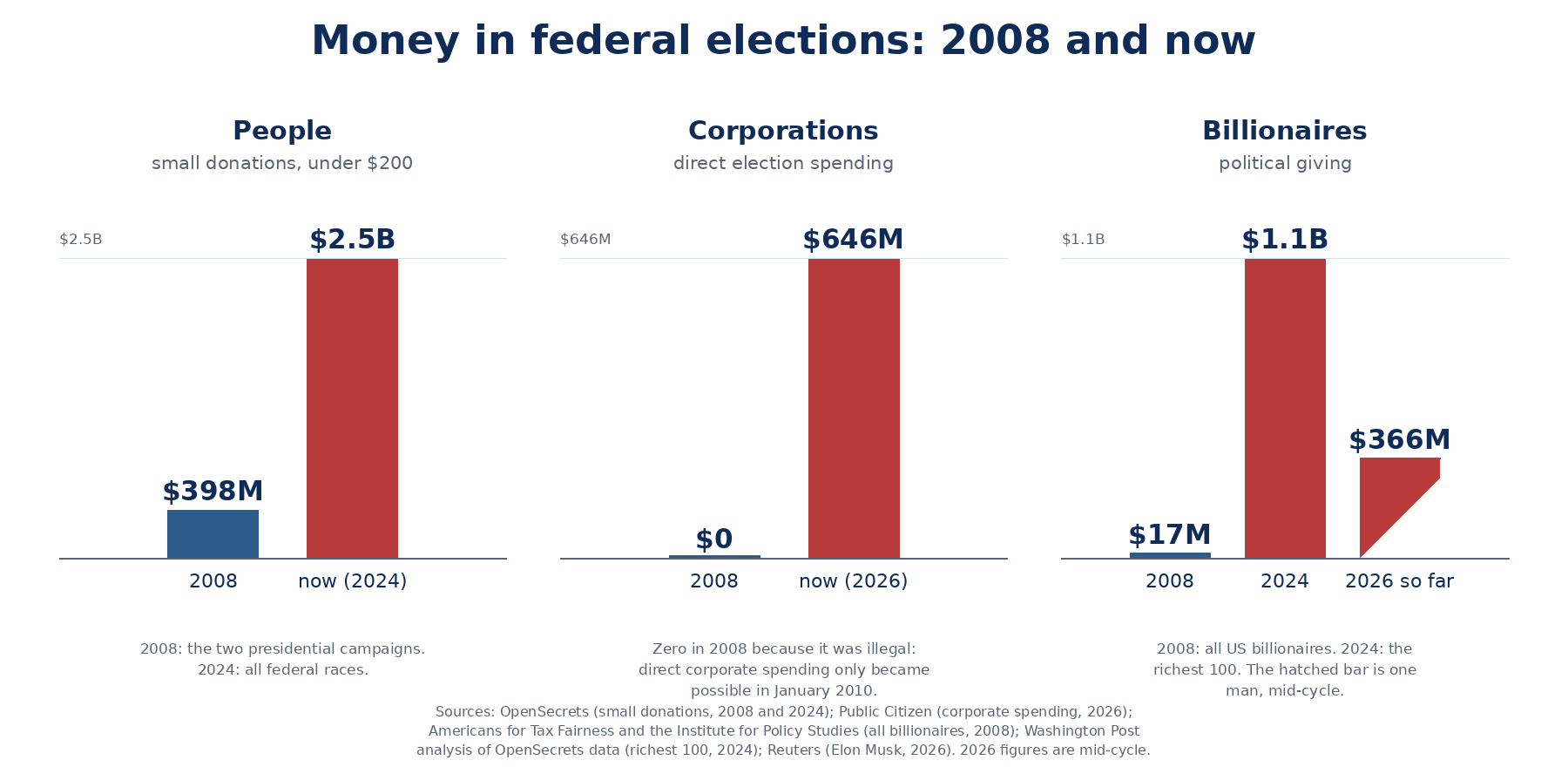
Now the other half of it: small donations across all federal races in 2024 came to about $2.5 billion, the richest 100 Americans gave $1.1 billion, and corporations have put in $646 million in the 2026 midterms alone. What one donor has spent this cycle, $366 million, is more than John McCain’s entire 2008 presidential campaign cost.
Where these come from: OpenSecrets on the 2006 and 2010 cycles, its ten-year report on the decade since, the PBS NewsHour analysis of the richest 100, FactCheck.org on the 2022 midterms, and Public Citizen on corporate spending in 2026. The Brennan Center’s five-year review covers the same ground.
What we are doing here
Our job in Coos County is not collecting names. It is the argument and the material: explaining what the measure does and why it is worth signing, making that case to neighbors and out in public, and putting the campaign’s fliers, buttons and QR sheets into people’s hands.
The petition to put it on the ballot cannot be signed yet. When the measure is cleared for circulation, this page and welcome@coosindivisible.org will be how you hear that it is time. Until then the work is being ready: take a stack of fliers, wear a button, and tell us what you are hearing out there.
Take the next step
You can also watch the launch video, and read the coverage and the filed amendment’s full text on the campaign’s media page. The Oregon Capital Chronicle covered the measure’s filing on September 9, 2026.
Materials to print and share
This is the campaign’s own material, hosted here so you can put it in people’s hands. Print what you need.
- Button sheet: six 2.25 in button faces (PDF): two pages, one with the campaign’s full logo and one with the round emblem alone. Print at 100% on paper or card stock, cut on the thin circle, and any pin-back button press can use the faces.
- One-page flier (PDF): what the measure does, with a QR code for volunteering. Print a stack and hand them out.
- Tabling QR sheet: volunteer signup (PDF): print it large, put it on a table, and people scan it with their phone.
- Tabling QR sheet: campaign updates (PDF): the same thing for people who just want to hear about it.
- Campaign logo, web version (PNG): for posts and emails.
- Campaign logo, print version (SVG): a scalable file for posters, signs and anything the print shop needs a big version of.
Get in touch
Email welcome@coosindivisible.org if you want materials in your hands, want to table at an event, or would rather talk it through before signing up. If you are with the campaign and need a Coos County contact, that address reaches us too.