FIREWALL FOR FREEDOM:
CITIES OF LIGHT
We are asking for transparency, accountability, and meaningful community oversight.
This is not about assuming bad intentions from our local police department.
It is about recognizing that
Our main ask
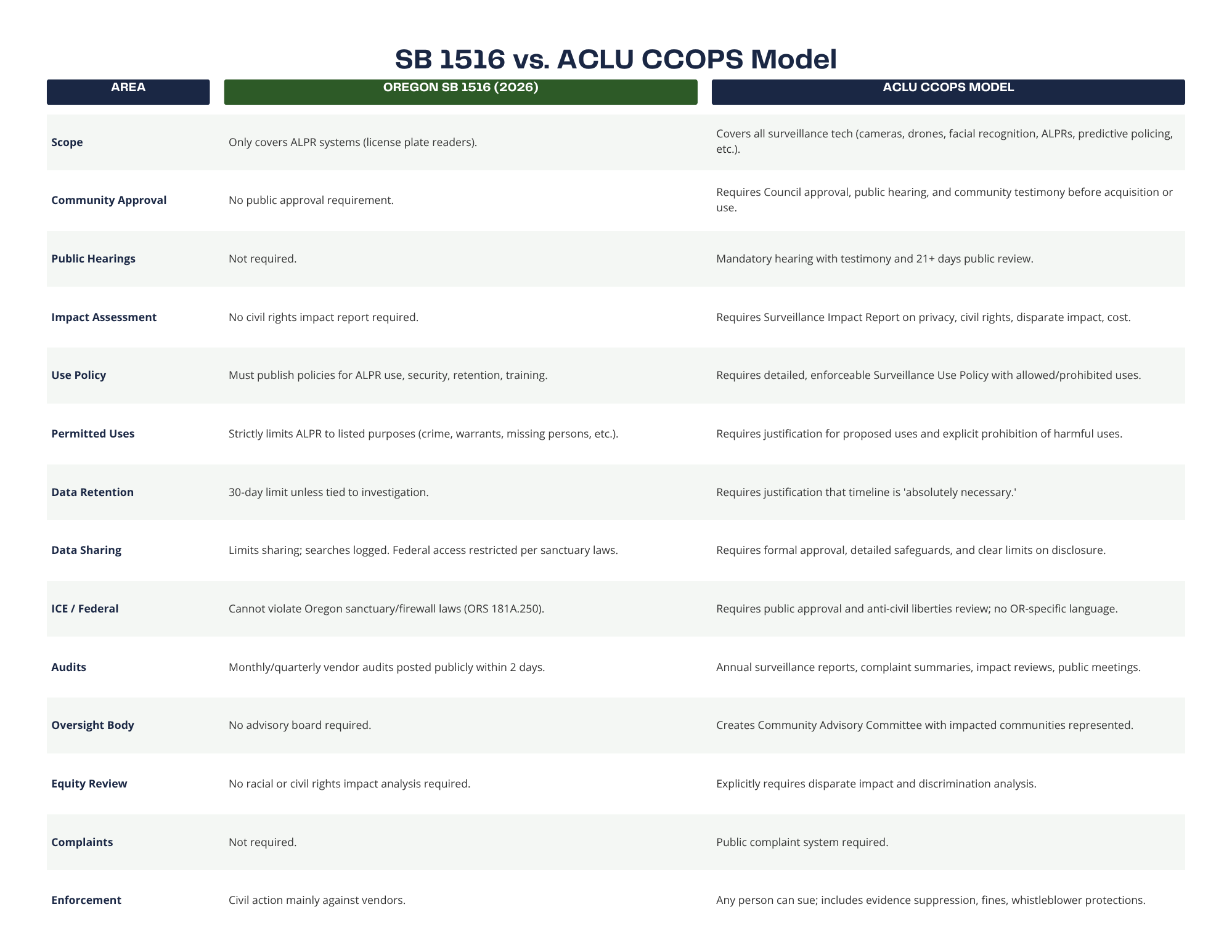
Adopt the CCOPS model: a community-centered oversight approach that ensures the people most impacted have a voice in how surveillance technology is used.
Speak From Your Own Experience
You do not need to be an expert. Use your own words and share:
- Why trust and transparency matter to you
- Why community members should have a voice in decisions affecting them
- Why civil rights protections matter
- Why written policies and accountability are important
Your lived experience is your expertise.
Key Points to Share
1) Show Us the Policy: Transparency Builds Trust
We are asking the city and police department:
Show us the policy. Put the safeguards in writing.
The community deserves to know:
- What rules govern this technology?
- Who can access the data?
- What agencies can request information?
- What training do officers receive?
- What happens if the system is misused?
Trust comes from transparency, not just reassurance.
2) Adopt CCOPS: Center the People Most Impacted
CCOPS creates a pathway for responsible technology oversight.
A strong oversight model includes:
- Community involvement
- Publicly available policies
- Accountability measures
- Regular review of how technology is used
- Representation from communities most likely to experience harm
People affected by surveillance technology should have a role in overseeing it.
3) Our Concerns Are Based on What We Have Seen Across the Country
Our concerns are not hypothetical.
Across the country, communities have raised concerns about surveillance technology expanding beyond its original purpose, including concerns about data access, mission creep, and impacts on civil rights.
The question is not only:
“Do we trust the people currently using this tool?”
The question is:
“What protections exist to make sure this technology is accountable now and in the future?”
Here is a concrete example of why the protections matter. In September 2026, Boston abandoned its Flock cameras because the company shared license plate data nationwide, including with federal agencies, in violation of its contract. The ACLU warns Flock is planning to plug into commercial data brokers that offer “people lookup” services.
Source: Ars Technica, “Boston dumps Flock, says it shared data nationwide” (September 2026); ACLU, “Flock’s Aggressive Expansions”.
Flock has also reinstalled cameras after cities canceled. In September 2026, the city of Dayton, Minnesota told Flock no work orders were to be completed after canceling its contract, but Flock placed a camera back into service without authorization, and staff found a second one reinstalled too. In Plymouth, Minnesota, Flock ignored the city’s cancellation for more than a week, so the police chief had his staff physically unplug the cameras. St. Paul and Crystal, Minnesota removed the cameras themselves. Flock owns the hardware even on property it doesn’t own, and it told Dayton it would take 60 days to remove the equipment.
Source: The Drive, “Flock Reinstalled Its Cameras After Another City Canceled Its Contract” (October 27, 2026).
4) We Need More Than Verbal Assurances
We appreciate assurances that safeguards exist.
But communities deserve:
- Written policies
- Public oversight
- Clear limits
- Accountability processes
Good systems should not depend only on individual intentions: they should have protections built in.
5) It Isn’t “Pictures Versus Video”: String the Stills Together
When this technology comes up, the standard defense is that these cameras don’t take video, they take 23 photos a second. The implication is that a stack of stills somehow isn’t a record of what happened.
String those 23 photos together and watch them, then watch a 30-frame-a-second video of the same car making the same run at the same speed. You cannot tell them apart. At the pace of a street, 23 stills a second reads as smooth, continuous video.
So the real question is not whether this is pictures or video. It is what a complete record of our streets looks like, and what rules govern how it is kept, shared, and used.
Top: 23 photos a second, strung together. Bottom: 30 frames a second. Same car, same speed, same run.
Closing Ask to Council
Please:
- Release the written policies, training materials, and data-sharing agreements.
- Provide transparency about who can access this information.
- Create meaningful community oversight through a CCOPS model.
- Ensure impacted community members have a voice in accountability.
Public safety and civil rights work together. Trust is built when communities are included, informed, and heard.
Those who would give up essential Liberty, to purchase a little temporary Safety, deserve neither Liberty nor Safety.
Benjamin Franklin
Documents
Contact: jess@coosindivisible.org